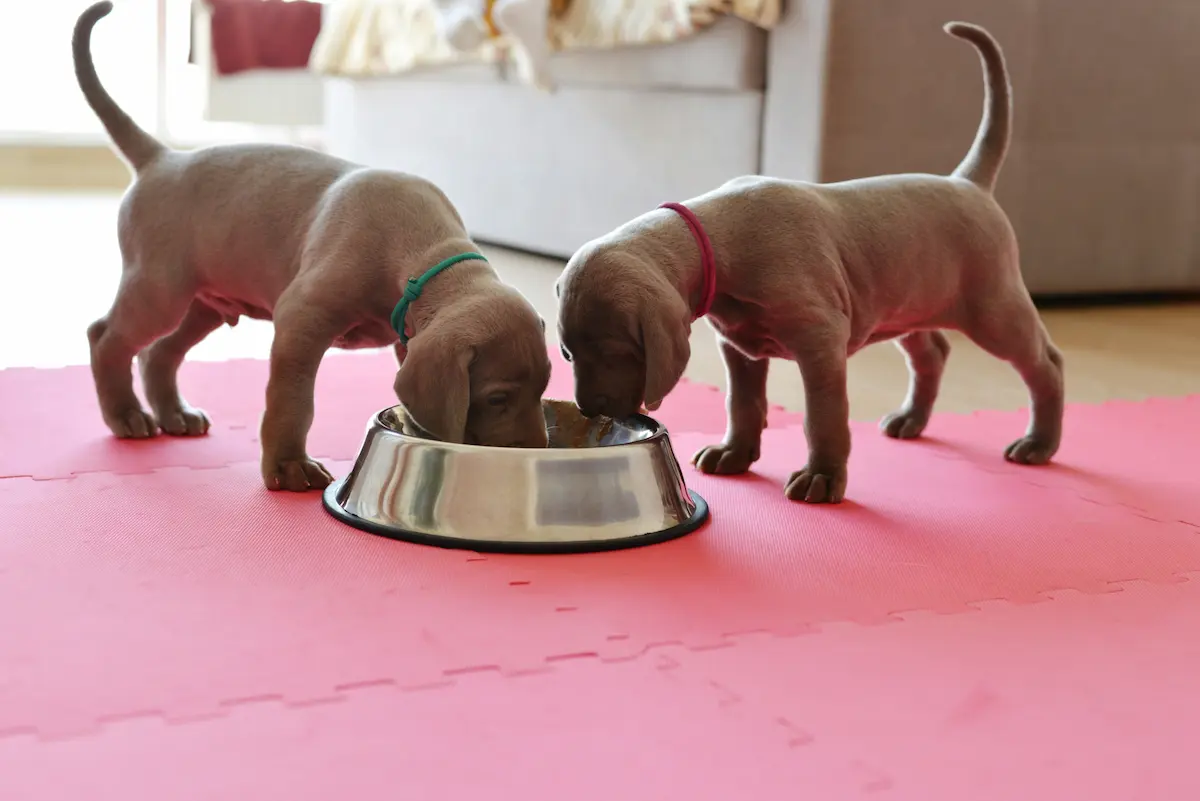
Bringing home a new puppy means navigating a feeding schedule that changes dramatically in the first few months. What a 6-week-old puppy needs is completely different from what a 4-month-old needs — and both are different from what a 6-month-old needs.
This guide covers exactly what to feed puppies at each stage of development, how to transition between stages, and what to watch for along the way.
Before We Begin — A Note on Breed Size
Feeding recommendations vary significantly based on expected adult size. Throughout this guide, keep your puppy's expected adult weight in mind:
- Small breed: Under 10kg adult weight (Chihuahua, Yorkshire Terrier, Toy Poodle)
- Medium breed: 10-25kg adult weight (Cocker Spaniel, Border Collie, Bulldog)
- Large breed: 25-45kg adult weight (Labrador, Golden Retriever, German Shepherd)
- Giant breed: Over 45kg adult weight (Great Dane, Saint Bernard, Mastiff)
Large and giant breed puppies have specific calcium and phosphorus requirements that make breed-size-appropriate food critical. Never feed a large breed puppy a standard puppy food — the calcium levels accelerate bone growth to rates that cause permanent skeletal damage.
Weeks 1-3 — Neonatal Stage (Mother's Milk Only)
During the first three weeks of life, puppies rely entirely on their mother's milk. This is not a stage where human intervention in feeding is appropriate unless the mother is unavailable or producing insufficient milk.
What puppies are getting from mother's milk:
- Colostrum in the first 24-48 hours — contains maternal antibodies that provide passive immunity
- Perfect protein and fat ratios for rapid growth
- Growth factors and hormones that support organ development
- Natural probiotics that establish gut microbiome
If mother is unavailable: Puppy milk replacer (Esbilac, Royal Canin Babydog Milk, or similar) is the only appropriate substitute. Never use cow's milk or goat's milk — the protein and fat ratios are wrong for puppies and cause digestive failure.
Feeding frequency for bottle-fed neonates:
- Week 1: Every 2 hours around the clock
- Week 2: Every 2-3 hours
- Week 3: Every 3-4 hours
This is intensive care — contact your veterinarian immediately if you are caring for neonatal puppies without a mother.
Weeks 3-4 — Transition Begins
Around 3-4 weeks puppies begin showing interest in solid food. Their eyes and ears are open and they start exploring the world — including their mother's food bowl.
What to introduce: Begin offering puppy milk replacer in a shallow dish. Puppies will walk through it, fall into it, and generally make a mess — this is normal. The goal at this stage is exposure not nutrition.
By week 4: Start mixing a small amount of high-quality puppy food (wet food or dry soaked to mush with warm water or puppy milk replacer) into the milk replacer. The consistency should be like thin porridge.
Feeding frequency: 4-6 times per day in small amounts alongside continued mother's milk.
What to watch for:
- Puppies gaining weight daily (weigh individually with a kitchen scale)
- All puppies getting access to food — monitor for competition
- Normal soft puppy stools — some looseness is expected during transition
Weeks 4-6 — Weaning
Weaning is a gradual process not a sudden switch. The goal is to slowly shift calories from mother's milk to solid food over 2-3 weeks.
Week 4-5 feeding approach:
- Offer moistened puppy food 3-4 times daily
- Gradually reduce the amount of liquid used to moisten food — moving toward a softer solid consistency
- Mother continues nursing as desired
Week 5-6 feeding approach:
- Begin offering dry puppy kibble moistened with warm water to a soft mash consistency
- 4 meals per day
- Begin separating puppies from mother for increasing periods to reduce nursing
What the food should look like: The texture should transition from soup to oatmeal to soft mash over these two weeks. Never offer dry hard kibble to puppies under 6-7 weeks — their teeth and jaws are not ready.
Choosing a weaning food:
- High-quality puppy food appropriate for the breed size
- Look for named animal protein as the first ingredient
- AAFCO statement for growth or all life stages
- DHA from fish oil or salmon oil for brain development
Weeks 6-8 — Post-Weaning
By 6-7 weeks most puppies are fully weaned or nearly so. Puppies typically go to their new homes at 8 weeks — the transition to a new home happens during this stage.
Feeding schedule:
- 3-4 meals per day
- Kibble can now be offered dry or with minimal moisture — puppies have enough teeth to manage soft kibble
- Continue the same food the breeder was using for at least the first 2 weeks in the new home
The breeder handover: Ask your breeder what food they have been feeding and continue that exact food for at least 2 weeks before transitioning to your preferred food. Combining a new home with a food change is a reliable recipe for digestive upset.
Portion guidance: Follow the feeding guide on your specific food as a starting point. For an 8-week-old puppy adjust based on weekly weight checks — puppies should be gaining weight consistently but not rapidly.
Weeks 8-12 — Settling In
This is the period when most puppies arrive at their new homes. The first priority is establishing routine — consistent feeding times, consistent amounts, and consistent food.
Feeding schedule:
- 3 meals per day: morning, midday, and evening
- Consistent times every day — this supports house training by creating predictable elimination timing
If transitioning to new food: Transition over 10-14 days:
- Days 1-4: 75% original food / 25% new food
- Days 5-8: 50% / 50%
- Days 9-12: 25% / 75%
- Day 13+: 100% new food
For puppies with sensitive stomachs extend the transition to 3-4 weeks.
What to expect:
- Some loose stools are normal during the transition to a new home and food — stress affects digestion
- Appetite may be reduced for the first few days in a new environment — this is normal
- Significant vomiting, blood in stool, or complete appetite loss warrants veterinary attention
Treats: Start introducing treats at this stage for training purposes. Keep treats to less than 10% of daily caloric intake. Use tiny treats — pea-sized pieces of plain cooked chicken, small pieces of carrot, or plain Cheerios are ideal training treats for puppies.
Months 3-4 — Rapid Growth Phase
This is one of the fastest growth periods for most breeds. Puppies are gaining weight rapidly and have significantly higher energy needs than they will as adults relative to body weight.
Feeding schedule:
- Continue 3 meals per day
- Increase portions as your puppy grows — use monthly weight checks and adjust
What to feed: Continue the breed-appropriate puppy food you established in weeks 8-12. Do not change foods unnecessarily during rapid growth periods — consistency supports digestive health and ensures reliable nutrition.
Large breed puppies — critical period: Months 3-4 are when skeletal development is most active for large breeds. Calcium intake must be controlled precisely during this period. Never supplement with calcium — the puppy food provides appropriate levels and supplementation causes dangerous excess. Never feed adult food or generic puppy food to large breed puppies.
Monitoring growth: Weigh your puppy monthly and compare against breed growth charts. Your vet can assess whether growth is appropriate at each puppy vaccination appointment. Under-growing suggests insufficient calories. Over-growing — particularly in large breeds — suggests too much food or inappropriate food.
Months 4-6 — Continued Development
Growth continues but at a slightly slower rate than the previous phase. Permanent teeth begin coming in around 4 months — this is the teething phase.
Feeding schedule:
- Reduce to 2-3 meals per day as appropriate for your puppy and lifestyle
- Many owners transition to twice daily at 4-6 months — this is appropriate for most puppies
Teething considerations: Puppies going through teething may have sore gums that make eating dry kibble less comfortable. Moistening kibble with warm water briefly or offering wet food during heavy teething periods helps. Frozen chew items like frozen carrots or frozen chicken wings (raw, supervised) provide teething relief alongside nutrition.
Treats and training: Training intensity often peaks during this period as puppies learn basic commands and house manners. Ensure treat calories are accounted for in daily food intake — reduce meal portions proportionally when using high-value training treats.
What to avoid:
- Table scraps — the variable fat and seasoning content disrupts digestive stability during a period when the digestive system is still developing
- Cooked bones — ever
- Excessive treats — obesity develops in puppies and is difficult to reverse
- Changing foods unnecessarily — consistency remains key
Months 6-9 — Approaching Adolescence
Smaller breeds may be approaching adult size by 6-9 months. Larger breeds are still growing significantly. This phase requires different approaches based on breed size.
Small breeds (6-9 months):
- Begin considering the transition to adult food — most small breeds are ready at 9-12 months
- Continue 2 meals per day
- Monitor for weight gain — small breeds can become overweight easily as growth slows
Medium breeds (6-9 months):
- Continue puppy food — medium breeds transition to adult food at 12 months
- 2 meals per day
- Adjust portions based on body condition — the growth rate is slowing and caloric needs may reduce slightly
Large breeds (6-9 months):
- Continue large breed puppy food — large breeds transition at 12-18 months
- 2 meals per day
- Do not reduce food too aggressively — they are still growing significantly
Spaying and neutering: Many puppies are spayed or neutered during this period. Spaying and neutering reduce metabolic rate and caloric needs. Reduce food by approximately 10-20% after the procedure and monitor body condition. Some puppies gain weight rapidly post-surgery if food is not adjusted.
Months 9-12 — Final Growth Phase
Most breeds except giant breeds are completing their growth during this period. Energy needs begin to decrease as growth slows.
Small breeds:
- Transition to adult food beginning at 9-10 months
- Transition gradually over 2 weeks
Medium breeds:
- Continue puppy food until 12 months
- Begin planning the adult food transition
Large breeds:
- Continue large breed puppy food until 12-18 months
- Do not rush the transition — the controlled calcium continues to support healthy bone completion
Giant breeds:
- Continue giant breed puppy food until 18-24 months
- Giant breeds mature significantly more slowly than other breeds
Transitioning to Adult Food
When the time comes to transition to adult food, follow the same gradual approach used for any food change.
Transition schedule:
- Days 1-4: 75% puppy food / 25% adult food
- Days 5-8: 50% / 50%
- Days 9-12: 25% / 75%
- Day 13+: 100% adult food
Signs the transition is going well:
- Normal stool consistency throughout
- Maintained appetite
- Stable weight appropriate for age and breed
Signs to slow the transition:
- Loose stools
- Reduced appetite
- Vomiting
Foods Never to Give Puppies at Any Age
Puppies are more vulnerable than adult dogs to toxic foods due to their smaller size and developing systems. A toxic dose that causes mild symptoms in a 30kg adult can be fatal for a 3kg puppy.
Never give puppies:
- Grapes or raisins — kidney failure with no established safe dose
- Chocolate — theobromine toxicity; dark chocolate most dangerous
- Xylitol — rapid liver failure; found in sugar-free gum, some peanut butters, baked goods
- Onions and garlic — hemolytic anemia; all forms including powder
- Macadamia nuts — neurological symptoms
- Raw bread dough — yeast expands and produces alcohol in the stomach
- Cooked bones — splinter into dangerous sharp shards
- Alcohol — fatal even in tiny amounts
- Caffeine — cardiac arrhythmias and seizures
- Avocado — persin toxicity
Frequently Asked Questions
My puppy is not eating — what should I do? A puppy that refuses food for more than 12 hours warrants veterinary attention. Brief appetite reduction in the first few days of a new home is normal. Adding warm water or a tiny amount of plain cooked chicken to kibble can improve palatability.
Can I feed my puppy raw food? Raw feeding for puppies is controversial. Bacterial contamination risks are real and puppies' developing immune systems are more vulnerable. If considering raw feeding consult a veterinary nutritionist to ensure complete nutrition and safe handling protocols.
My puppy is always hungry — am I feeding enough? Puppies are frequently hungry even when adequately fed — it is normal puppy behaviour. Check that portions match your food's feeding guide adjusted for current weight. If your puppy's ribs are prominent they may need more food. If they have no visible waist they are likely getting enough or too much.
Can puppies eat adult dog food in an emergency? One or two meals of adult food in a genuine emergency is unlikely to cause harm. However large breed puppies should not eat standard adult food regularly — the calcium and phosphorus ratios are wrong for their development.
When should I start giving my puppy treats? You can begin offering tiny training treats as soon as your puppy comes home at 8 weeks. Keep treats to less than 10% of daily calories. Use puppy-appropriate small low-calorie treats.
Photo by Liana S on Unsplash